
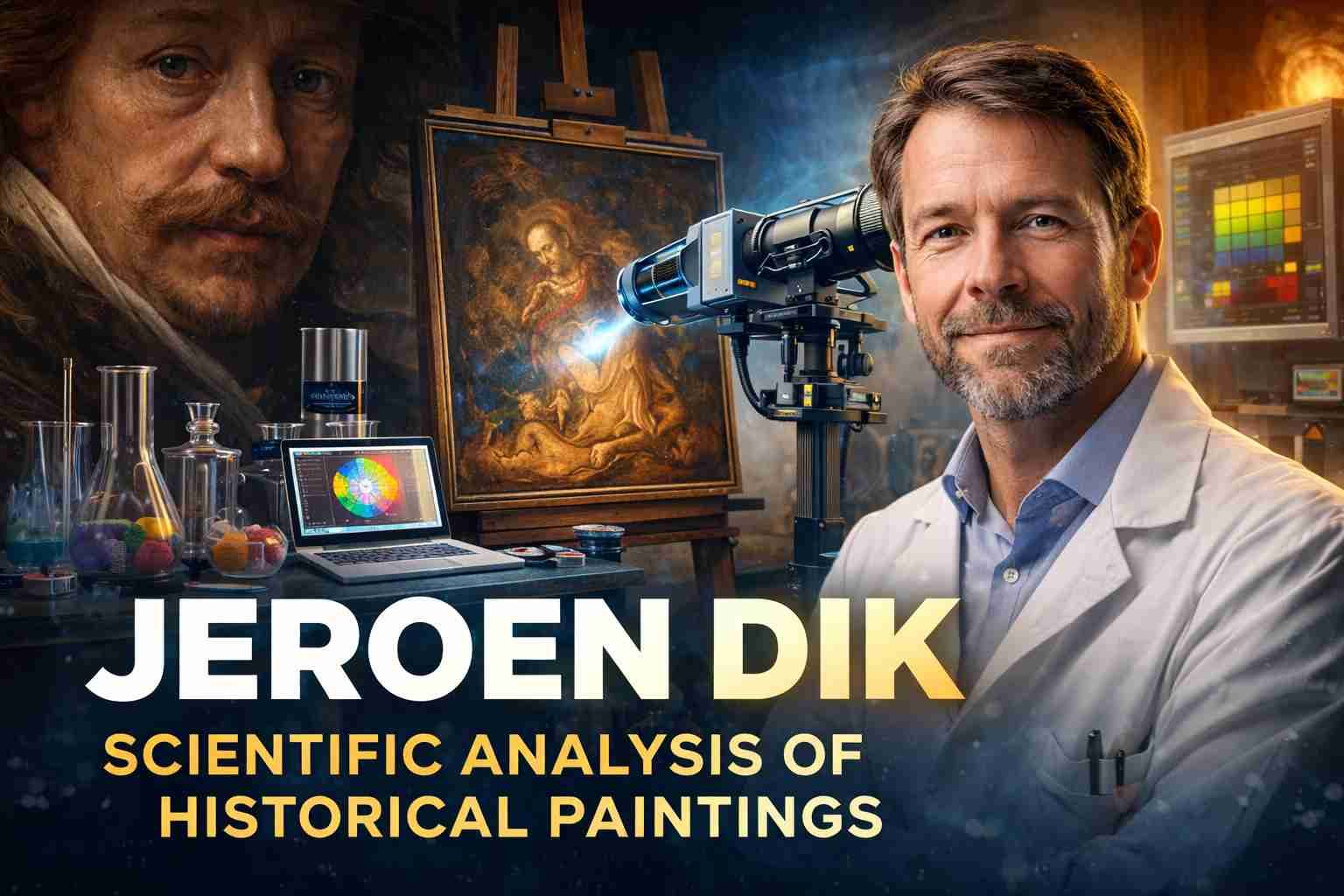
Jeroen Dik: Scientific Authority in Technical Art History
Jeroen Dik is a Dutch materials scientist recognized for advancing technical art history through scientific analysis. Academic institutions and museums document his role in integrating physics, chemistry, and art conservation into a single research framework. His work focuses on understanding how historical paintings are constructed, altered, and preserved at the material level.
Jeroen Dik operates at the intersection of heritage science and materials engineering. Delft University of Technology lists him as a senior academic researcher specializing in non-destructive analytical methods for cultural heritage. His research output supports museums, conservators, and art historians with verifiable material evidence.
Academic and Institutional Profile of Jeroen Dik
Jeroen Dik holds formal training in physics and materials science. Delft University of Technology confirms his affiliation with the Faculty of Applied Sciences. His academic position centers on research leadership rather than general instruction, which distinguishes his role from traditional art historians.
His institutional profile shows sustained collaboration with European museums, conservation laboratories, and scientific consortia. These partnerships position him as a reference authority in heritage science research networks.
Core Research Domains Associated With Jeroen Dik
Jeroen Dik focuses on measurable and repeatable scientific processes applied to historical artworks. His research domains include:
-
Paint layer stratigraphy
-
Pigment and binder identification
-
Elemental mapping of artworks
-
Degradation chemistry of historical paints
-
Non-invasive imaging technologies
Each domain is supported by peer-reviewed research published in conservation science and applied physics journals.
Scientific Methods Used by Jeroen Dik
Non-Destructive Imaging Technologies
Jeroen Dik is widely associated with macro X-ray fluorescence (macro-XRF) scanning. Scientific publishers describe macro-XRF as a technique that maps elemental composition across entire paintings without physical contact.
Macro-XRF enables:
-
Detection of hidden compositions
-
Identification of elemental pigments
-
Visualization of underdrawings
-
Analysis of compositional changes
This method preserves the structural integrity of artworks while delivering high-resolution material data.
Spectroscopic and Microscopic Analysis
Jeroen Dik applies complementary analytical tools to support imaging data. These tools include:
-
Fourier-transform infrared spectroscopy (FTIR)
-
Raman spectroscopy
-
Optical and electron microscopy
Each method confirms molecular and crystalline structures of paint materials. Combined analysis strengthens result reliability.
Role of Jeroen Dik in Rembrandt Research
Jeroen Dik is strongly linked to scientific studies of Rembrandt van Rijn’s paintings. The Rijksmuseum and related research programs document collaborative projects involving his analytical contributions.
His studies reveal:
-
Altered compositions beneath visible paint layers
-
Layering strategies unique to Rembrandt
-
Material choices consistent with 17th-century Dutch workshops
These findings refine historical understanding of Rembrandt’s working process using measurable data rather than stylistic interpretation alone.
See More: Roblox Unblocked: A Comprehensive, SEO-Focused Explanation
Contribution to Technical Art History
Technical art history focuses on how artworks are physically created. Jeroen Dik contributes by replacing speculative assumptions with empirical material evidence.
His contributions include:
-
Scientific validation of artistic techniques
-
Reconstruction of historical painting workflows
-
Correlation between material choices and visual outcomes
Museums reference this work to support cataloging, attribution, and conservation decisions.
Impact on Museum Conservation Practices
Scientific data produced by Jeroen Dik informs conservation strategies. Conservation standards emphasize evidence-based decision-making, which aligns with his research outputs.
His work supports:
-
Safe cleaning protocols
-
Stabilization of chemically unstable paints
-
Long-term preventive conservation planning
Museums rely on this data to reduce irreversible intervention risks.
Interdisciplinary Collaboration Framework
Jeroen Dik collaborates with professionals across multiple disciplines:
-
Art conservators
-
Curators
-
Analytical chemists
-
Physicists
-
Art historians
This interdisciplinary model ensures scientific results remain historically relevant and ethically sound.
Data Interpretation and Material Mapping
Elemental and molecular maps produced through imaging require expert interpretation. Jeroen Dik applies standardized analytical frameworks recognized in materials science.
Interpretive outcomes include:
-
Differentiation between original and later paint layers
-
Identification of pigment mixtures
-
Detection of restoration materials
These interpretations improve transparency in art historical documentation.
Educational and Knowledge Transfer Role
Jeroen Dik contributes to higher education through specialized heritage science instruction. University documentation confirms his involvement in training researchers in analytical art methods.
Educational focus areas include:
-
Scientific instrumentation for art analysis
-
Interpretation of material data
-
Ethical research practices in conservation science
This training ensures methodological continuity in future research.
Publications and Scholarly Output
Academic databases index numerous peer-reviewed articles authored or co-authored by Jeroen Dik. His publications address:
-
Imaging technology applications
-
Historical pigment characterization
-
Conservation science methodology
These articles serve as reference points in international heritage science literature.
Technology Development and Instrument Innovation
Jeroen Dik contributes to improving analytical instruments used on artworks. Applied physics research documents his involvement in adapting scanning technologies for fragile cultural objects.
Key improvements include:
-
Reduced radiation exposure
-
Portable scanning systems
-
Higher spatial resolution
Instrument adaptation expands museum-based research capabilities.
Ethical Standards in Jeroen Dik’s Research
International conservation ethics require minimal intervention and maximum preservation. Jeroen Dik’s research adheres to these principles.
Ethical alignment includes:
-
Avoidance of destructive sampling
-
Transparent data reporting
-
Reproducible scientific methods
This compliance reinforces institutional trust in his findings.
Influence on Artwork Attribution
Material evidence plays a role in attribution studies. Jeroen Dik’s research supports attribution by correlating material signatures with known historical practices.
Scientific attribution support includes:
-
Pigment availability by period
-
Workshop-specific material usage
-
Layer construction patterns
These data sets complement stylistic and documentary analysis.
Read Also: How to understand ETraderAI as a standalone trading intelligence concept
Structured Overview of Jeroen Dik’s Contributions
| Area of Contribution | Scientific Value | Institutional Impact |
|---|---|---|
| Macro-XRF Imaging | Elemental mapping | Museum research |
| Pigment Analysis | Material accuracy | Conservation planning |
| Paint Degradation | Chemical stability | Preventive conservation |
| Technical Art History | Workflow reconstruction | Art historical clarity |
Facts About Jeroen Dik
-
Jeroen Dik operates primarily within applied sciences rather than art departments.
-
His research prioritizes full-painting analysis instead of micro-sampling.
-
His methods allow comparison across large painting collections.
-
Museums use his data in permanent collection records.
Frequently Asked Questions About Jeroen Dik
What is Jeroen Dik known for?
Jeroen Dik is known for applying materials science and non-destructive imaging to the study of historical paintings.
Is Jeroen Dik an art historian?
Jeroen Dik is a materials scientist working in technical art history rather than a traditional art historian.
Which university is Jeroen Dik affiliated with?
Delft University of Technology documents his academic affiliation.
What makes Jeroen Dik’s research unique?
His research analyzes entire paintings using advanced imaging rather than isolated samples.
Does Jeroen Dik work with museums?
Museum publications confirm long-term collaboration with institutions such as the Rijksmuseum.
Why is macro-XRF important in his work?
Macro-XRF provides elemental maps that reveal hidden paint layers without damaging artworks.
Conclusion
Jeroen Dik represents a data-driven transformation in art research. Academic institutions, museums, and conservation bodies recognize his work for introducing measurable scientific standards into the study of historical paintings. His research strengthens preservation accuracy, historical understanding, and methodological transparency across heritage science.


