
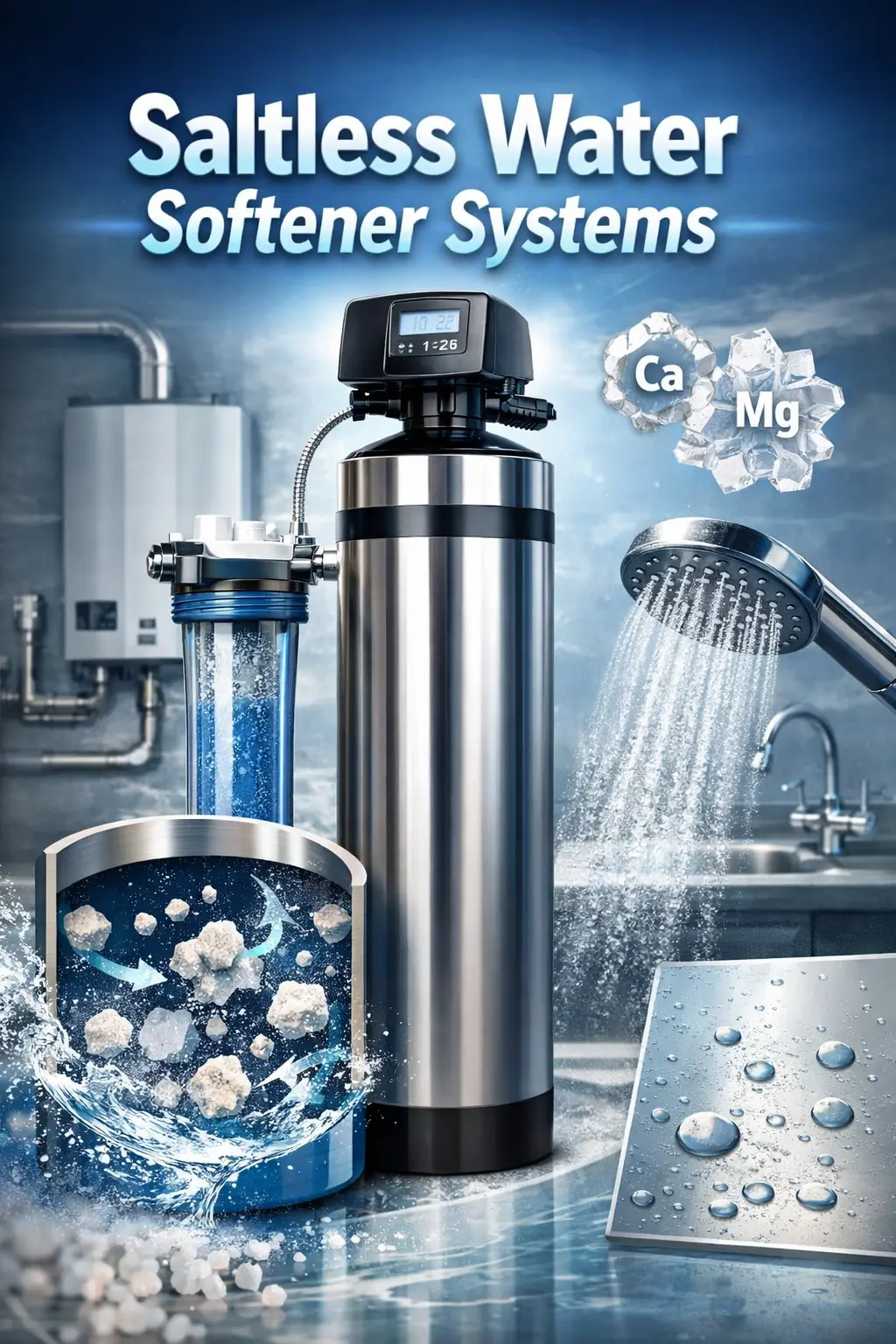
Overview of Modern Water Conditioning Without Salt
A saltless water softener is categorized as a scale management system rather than a hardness removal device. According to the U.S. Environmental Protection Agency (EPA), non-salt technologies modify mineral behavior instead of extracting calcium and magnesium ions from water. This distinction defines the system’s role in plumbing protection and water chemistry preservation.
The system restructures dissolved minerals into stable crystalline forms that do not adhere to internal surfaces. These crystals remain suspended in water flow and exit through fixtures without forming deposits. This mechanism limits scale accumulation inside pipes, valves, and heating equipment while maintaining natural mineral content.
Unlike ion-exchange systems, this approach avoids sodium addition, brine discharge, and regeneration cycles. The result is a conditioning method aligned with environmental compliance and reduced operational complexity.
Operating Principles Behind Salt-Free Conditioning
Salt-free conditioning operates through physical transformation processes rather than chemical substitution. Industry-recognized methods include Template-Assisted Crystallization (TAC), Nucleation-Assisted Crystallization (NAC), and electromagnetic mineral conditioning.
Template-Assisted Crystallization
Template-Assisted Crystallization uses engineered media containing nucleation sites. As hard water passes through the media, calcium carbonate converts into aragonite microcrystals. Aragonite does not bind to metal or polymer surfaces. The Water Quality Association (WQA) validates this process for repeatable scale reduction under controlled conditions.
Nucleation-Assisted Crystallization
Nucleation-Assisted Crystallization promotes early mineral bonding within the water stream. This bonding occurs before minerals contact plumbing surfaces, reducing deposition across distribution systems.
Electromagnetic Conditioning
Electromagnetic systems apply oscillating fields to influence ionic charge behavior. Performance varies based on flow rate, pipe material, and mineral concentration, as documented in independent laboratory assessments.
Structural Design and System Components
A salt-free conditioning unit uses a simplified internal layout focused on mineral transformation rather than exchange.
See More: Understanding Lyposingrass as a Distinct Scientific Concept
| Component | Functional Role |
|---|---|
| Catalytic or Ceramic Media | Alters crystal structure of minerals |
| Containment Housing | Directs controlled water flow |
| Bypass Valve Assembly | Enables servicing without shutdown |
| Sediment Prefilter | Prevents particulate interference |
| Inlet and Outlet Ports | Connects to main supply line |
The absence of resin beds, brine tanks, and drain lines reduces mechanical stress and long-term maintenance demands.
Comparison With Ion-Exchange Softening Systems
Traditional softening systems and non-salt conditioners address different objectives.
| Attribute | Non-Salt Conditioning | Ion-Exchange Softening |
|---|---|---|
| Mineral Extraction | No | Yes |
| Sodium Introduction | None | Present |
| Wastewater Production | None | High |
| Scale Prevention | High | High |
| Maintenance Frequency | Low | Moderate |
| Environmental Impact | Minimal | Elevated chloride output |
Ion-exchange systems replace calcium with sodium ions. Conditioning systems maintain mineral presence while neutralizing scale adhesion behavior.
Performance Characteristics and Measured Outcomes
Performance evaluation focuses on scale inhibition efficiency rather than hardness reduction. Research published by the Water Quality Research Foundation demonstrates up to 99% reduction in scale accumulation when operating within specified hardness thresholds.
Measured parameters remain stable:
-
Total dissolved solids
-
Conductivity levels
-
pH balance
These outcomes preserve drinking water integrity while protecting plumbing infrastructure.
Installation Profile and Space Requirements
Systems install at the point of entry on the main water line. No drain connection is required. TAC and NAC systems operate without electrical power.
Typical installation parameters include:
-
Installation duration: 1–2 hours
-
Pressure loss: under 5 PSI
-
Physical footprint: compact vertical housing
This configuration supports placement in utility rooms, garages, or mechanical spaces.
Maintenance Expectations and Media Longevity
Operational upkeep remains minimal. No salt refilling occurs. No regeneration cycles take place. Conditioning media lifespan averages three to six years, depending on water chemistry and usage volume.
Routine service tasks include:
-
Sediment filter replacement
-
Visual inspection of fittings
-
Periodic flow verification
The absence of stagnant brine reservoirs reduces microbial growth risk, as noted by public health agencies.
Water Chemistry Compatibility Factors
System effectiveness depends on incoming water quality. Optimal parameters include:
-
Hardness levels below 17 grains per gallon
-
pH range between 6.8 and 8.5
-
Iron concentration below 0.3 mg/L
-
Manganese concentration below 0.05 mg/L
Pretreatment filtration improves performance when sediment or metals exceed recommended thresholds.
Plumbing and Appliance Protection Benefits
Scale control systems protect:
-
Tankless water heaters
-
Boilers and heat exchangers
-
Dishwashers and washing machines
-
Valves and fixtures
The Electric Power Research Institute confirms that scale-free heating surfaces maintain higher thermal efficiency and consistent energy transfer over time.
Environmental and Regulatory Considerations
Non-salt conditioning eliminates regeneration waste. Traditional softeners discharge significant volumes of brine into wastewater systems. Conditioning systems discharge zero wastewater.
Environmental advantages include:
-
Reduced chloride contamination
-
Lower wastewater treatment burden
-
Compliance with regional discharge regulations
Several U.S. states encourage adoption due to freshwater protection initiatives.
Functional Constraints and Limitations
These systems do not produce softened water. Fabric feel remains unchanged. Mineral spotting may still appear, though adhesion strength decreases significantly.
They do not remove:
-
Dissolved iron
-
Sulfur compounds
-
Pathogenic organisms
-
Heavy metals
Additional filtration systems address contaminant removal when required.
Suitable Applications and Use Scenarios
Salt-free conditioning systems align with:
-
Homes using tankless heating equipment
-
Regions with brine discharge restrictions
-
Users avoiding sodium intake
-
Low-maintenance residential environments
Commercial applications include cafés, laboratories, and food preparation facilities where scale prevention is critical.
See More: Syracuse UV: Advanced Ultraviolet Disinfection Systems and Applications
Frequently Asked Questions
Does non-salt conditioning remove hardness minerals?
No. Minerals remain present, but their ability to form scale is reduced.
Is drinking water quality affected?
No. Mineral composition and taste remain unchanged.
How often does the media require replacement?
Replacement typically occurs every three to six years.
Are these systems compatible with tankless heaters?
Yes. Reduced scale formation supports heat transfer efficiency.
Do certifications apply to these systems?
Many units meet NSF/ANSI 42, NSF/ANSI 61, or WQA scale control standards.
Conclusion:
Salt-free conditioning systems provide documented scale prevention without chemical exchange or wastewater discharge. Industry organizations and regulatory agencies recognize their role in protecting plumbing infrastructure while maintaining natural water chemistry. These systems represent a durable, environmentally compliant solution within modern water treatment architecture.


