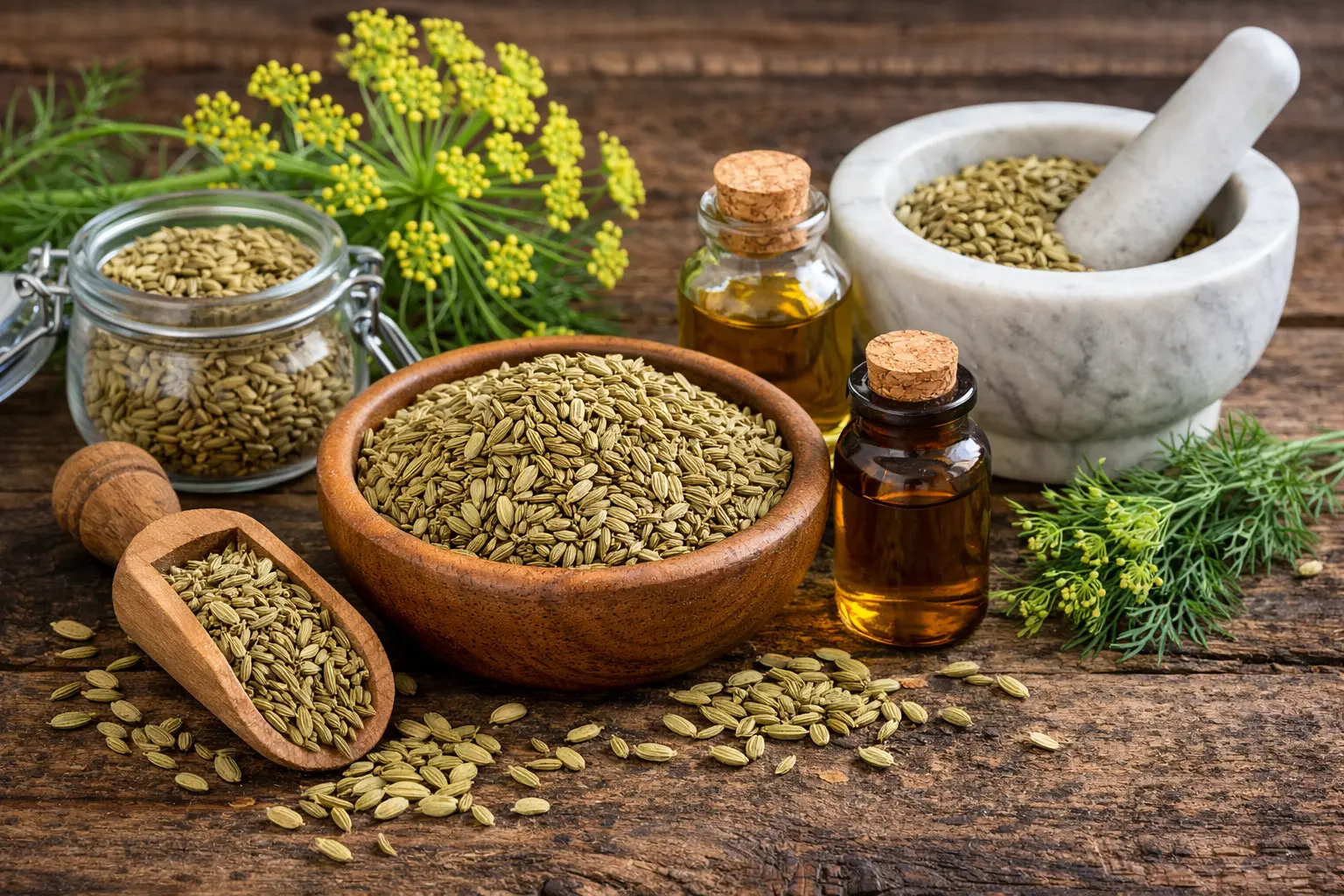

Fennel seeds are the dried fruits of Foeniculum vulgare, a flowering plant in the Apiaceae family. The seeds function as a culinary spice, a phytochemical source, and a traditional botanical ingredient. Global food systems, pharmacognosy references, and agricultural standards recognize fennel seeds for their aromatic stability, chemical density, and multifunctional applications.
Fennel seeds originate from a perennial herb characterized by feathery leaves and yellow umbel flowers. The plant develops schizocarp fruits that separate into two mericarps, commonly identified as seeds. Each seed contains longitudinal ridges and internal oil canals called vittae. These canals store volatile oils responsible for aroma and bioactivity. Botanical authorities classify Foeniculum vulgare as a diploid species adapted to temperate and semi-arid regions.
Fennel seeds contain a complex chemical matrix dominated by essential oils, structural carbohydrates, and secondary metabolites. Anethole represents the primary aromatic compound, often exceeding 70 percent of total volatile oil content. Fenchone, limonene, and estragole occur in smaller proportions. Non-volatile components include cellulose, hemicellulose, proteins, and mineral salts. This composition explains both sensory properties and functional behavior.
See More: Pravi Celer: Detailed Guide to Characteristics, Uses, Nutrition & Culinary Importance
Fennel seeds exhibit high nutrient density relative to weight. Dietary fiber represents the dominant macronutrient. Protein content contributes to nitrogen balance. Lipid fractions consist primarily of unsaturated fatty acids. Mineral content includes calcium, iron, magnesium, manganese, and potassium. These nutrients support structural, enzymatic, and electrolyte related functions.
| Nutrient Component | Approximate Value |
|---|---|
| Dietary Fiber | 30–40 g |
| Protein | 15–16 g |
| Total Fat | 14–15 g |
| Calcium | 1100–1200 mg |
| Iron | 18–20 mg |
| Potassium | 1600–1700 mg |
Fennel seeds contain flavonoids, phenolic acids, and terpenoids. Quercetin glycosides and kaempferol derivatives appear in trace but active quantities. Phenylpropanoids contribute to antioxidant potential. These compounds interact with oxidative pathways, microbial membranes, and enzymatic systems. The phytochemical diversity supports multiple functional roles without reliance on a single compound.
Fennel seed extracts demonstrate measurable free radical scavenging activity. Phenolic hydroxyl groups donate electrons to reactive oxygen species. This activity limits lipid oxidation in food systems and biological models. The antioxidant profile contributes to shelf-life extension when seeds are used in culinary or preservative contexts.
Fennel seeds exhibit carminative behavior due to volatile oil action on smooth muscle tissue. Anethole relaxes intestinal spasms and reduces gas accumulation. Traditional and modern references associate fennel seeds with gastric secretion modulation and intestinal motility balance. These effects occur without stimulant laxative activity.
Essential oil fractions from fennel seeds inhibit the growth of gram-positive and gram-negative bacteria. Cell membrane disruption represents the primary mechanism. Antifungal activity appears against common spoilage organisms. These properties explain the historical use of fennel seeds in food preservation and oral hygiene preparations.
Fennel seeds contain phytoestrogenic constituents derived from phenylpropanoids. These compounds exhibit weak affinity for estrogen receptors. The interaction remains non-synthetic and dose-sensitive. Scientific literature documents this property without classifying fennel seeds as hormonal agents.
Volatile oils in fennel seeds support mucus regulation in the respiratory tract. The aromatic compounds promote expectoration through reflex pathways. Herbal pharmacopeias list fennel seeds as adjunct components in respiratory formulations, particularly for dry cough conditions.
Fennel seeds provide potassium and soluble fiber, both associated with lipid metabolism and vascular tone. Potassium contributes to intracellular fluid balance. Fiber interacts with bile acids and cholesterol pathways. These associations align with general nutritional science frameworks.
Fennel seeds function as a flavoring agent in baked goods, spice blends, and fermented foods. Heat exposure releases aromatic oils, enhancing sweetness and anise-like notes. Indian, Mediterranean, and Middle Eastern cuisines integrate fennel seeds for both flavor and digestive balance. Roasting modifies volatile profiles without eliminating functional compounds.
Fennel seed oil appears in pharmaceutical syrups, lozenges, and mouth rinses. Standardized extracts enter nutraceutical formulations. The seeds also serve as raw material for perfumery and cosmetic emulsions due to aromatic stability.
Fennel plants thrive in well-drained loamy soils with moderate sunlight. Seed yield depends on umbel density and climatic stability. India, China, Egypt, and Turkey rank as leading producers. Harvesting occurs when seed heads mature and turn brown, indicating optimal oil concentration.
International spice standards define fennel seed quality by moisture content, oil percentage, and foreign matter limits. Gas chromatography confirms volatile composition. High-grade seeds exhibit strong aroma, uniform size, and intact ridges.
Fennel seeds retain quality when stored in airtight containers away from light and heat. Volatile oils degrade under oxidative conditions. Proper storage maintains aroma and functional integrity for extended periods.
Fennel seeds demonstrate a wide margin of safety as a food ingredient. Regulatory evaluations focus on estragole exposure limits. Normal culinary usage remains within accepted thresholds. Allergenic cross-reactivity may occur in individuals sensitive to Apiaceae plants.
Fennel plants support pollinator populations through nectar-rich flowers. The crop integrates well into sustainable agricultural systems. Moderate water requirements and adaptability reduce environmental pressure.
Fennel seeds contain higher fenchone levels and exhibit a milder sweetness compared to anise seeds, which have a sharper licorice profile.
Heat alters volatile oil composition but does not eliminate fiber or mineral content. Controlled roasting preserves functional value.
Fennel seeds are classified as a spice because they originate from the dried fruit rather than leaves or stems.
Quality assessment uses gas chromatography for oil profiling and moisture analysis for storage stability.
Fennel seeds serve as raw material for essential oils used in cosmetics, oral care products, and fragrance formulations.
See More: Crocolini: Brand Definition, Product Features, and Market Overview
Fennel seeds represent a botanically defined, chemically complex, and nutritionally dense plant derived ingredient. Culinary relevance, phytochemical diversity, and agricultural sustainability converge within a single seed structure. Scientific validation, traditional usage, and industrial application establish fennel seeds as a comprehensive functional resource across multiple domains.