Twin Size Bed: Comprehensive Technical, Functional, and Practical Guide
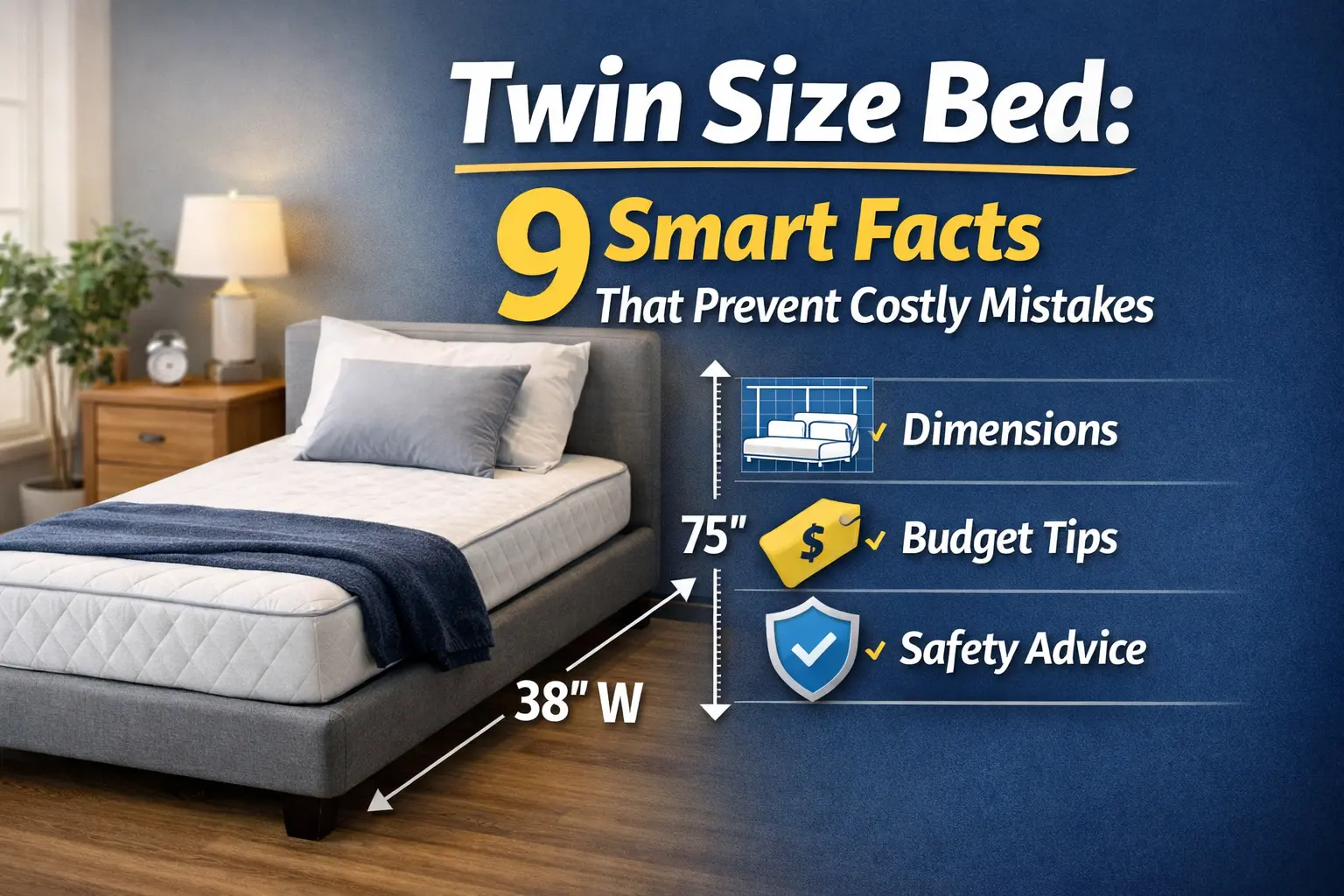
A twin size bed is a standardized single occupancy sleeping unit defined by fixed dimensional, structural, and functional parameters. According to the International Sleep Products Association (ISPA) and ANSI bedding standards, a twin size bed measures 38 inches in width and 75 inches in length. This size classification establishes the smallest adult recognized mattress category used in residential, institutional, and commercial environments.
A twin size bed delivers a sleep surface of 2,850 square inches, enabling controlled posture alignment for one occupant. The Consumer Product Safety Commission (CPSC) recognizes twin beds as compliant when paired with certified mattresses and frames meeting flammability and load-bearing regulations.
How a twin size bed fits within standardized bed classifications
To understand a twin size bed correctly, it must be placed within the global mattress size taxonomy. The International Organization for Standardization (ISO) and ISPA list the twin bed as the baseline reference for single-sleeper furniture.
| Bed Type | Width (inches) | Length (inches) | Occupancy |
|---|---|---|---|
| Twin | 38 | 75 | Single |
| Twin XL | 38 | 80 | Single |
| Full | 54 | 75 | Single / Compact Double |
| Queen | 60 | 80 | Double |
The twin size bed remains unique due to its minimal width and compatibility with modular furniture systems.
See More: Definition and Classification of Low Rise Jeans
How to use a twin size bed efficiently
To use a twin size bed efficiently, align its dimensions with room geometry, sleeper height, and intended function. The American Society of Interior Designers (ASID) identifies twin beds as optimal for rooms measuring 70–100 square feet.
A twin size bed supports streamlined spatial circulation. Clearance requirements remain lower than larger bed formats. The National Association of Home Builders (NAHB) lists twin beds as preferred for narrow floor plans and multifunctional rooms.
Structural components of a twin size bed
Frame construction standards
Twin size bed frames follow standardized structural engineering practices. The American Society for Testing and Materials (ASTM) specifies load distribution testing for residential bed frames.
Common frame materials include:
-
Solid hardwood such as pine, maple, or oak
-
Engineered wood such as plywood and MDF
-
Powder-coated steel or aluminum tubing
Solid wood frames exhibit higher torsional resistance. Metal frames demonstrate superior fatigue endurance. These classifications are documented by the Furniture Industry Research Association (FIRA).
Slat and support systems
Twin beds use either:
-
Parallel wooden slats
-
Grid-style metal platforms
-
Box spring foundations
The Sleep Products Safety Council identifies slat spacing under 3 inches as optimal for mattress integrity.
Twin size bed mattress specifications
Mattress thickness and density
Twin mattresses range from 6 to 12 inches in thickness. Mattress density influences pressure dispersion and durability. The CertiPUR-US certification program defines acceptable foam density thresholds for longevity and emission control.
| Mattress Type | Average Density | Performance Attribute |
|---|---|---|
| Innerspring | Coil-based | Airflow regulation |
| Memory Foam | 3–5 lb/cu ft | Pressure redistribution |
| Latex | Natural/Synthetic | Elastic responsiveness |
| Hybrid | Mixed layers | Structural balance |
Applications of a twin size bed across environments
Residential use
Twin size beds dominate children’s rooms, teen bedrooms, and compact adult sleeping spaces. The American Academy of Pediatrics (AAP) recognizes twin beds as developmentally appropriate for children transitioning from cribs.
Educational and institutional housing
Universities specify twin or twin XL beds for dormitories. The Association of College & University Housing Officers (ACUHO-I) documents twin formats as space-optimized and maintenance-efficient.
Hospitality and healthcare settings
Twin beds appear in recovery rooms, extended-stay lodging, and shared accommodations. The Healthcare Furniture Association lists twin beds for compliance with patient mobility standards.
Twin size bed compatibility and modular use
Bunk beds and loft systems
Twin beds function as the default mattress size for bunk and loft configurations. The ASTM F1427 safety standard mandates twin-only mattress usage for guardrail clearance compliance.
Trundle and under bed storage
Twin beds support trundle systems due to uniform length and reduced height constraints. The Business and Institutional Furniture Manufacturers Association (BIFMA) confirms twin bed dimensional compatibility with standardized storage units.
Safety, weight capacity, and compliance
Twin size beds maintain defined load thresholds. Residential frames typically support 250–400 pounds, depending on construction material and joint design. These values are verified using ASTM static and cyclic load testing protocols.
Fire resistance compliance follows CPSC 16 CFR Part 1633 standards when paired with certified mattresses.
Environmental and sustainability considerations
Material certification
Sustainable twin size beds use:
-
FSC-certified wood
-
Low-VOC finishes
-
GREENGUARD-certified foams
The Environmental Protection Agency (EPA) identifies low-emission bedding as a contributor to improved indoor air quality.
Lifecycle efficiency
Twin beds demonstrate reduced material consumption per unit. The EPA Sustainable Materials Management Program classifies smaller furniture footprints as resource-efficient over extended lifecycles.
Twin size bed maintenance and longevity
Mattress care
Rotate twin mattresses every 3–6 months to ensure uniform compression. The Sleep Foundation associates rotation with extended structural integrity.
Frame maintenance
Inspect fasteners annually. Tighten joints and replace worn slats promptly. The Home Furnishings Association (HFA) lists routine inspection as essential for load stability.
Cost structure and market positioning
Twin size beds occupy the lowest price tier among adult bed sizes. According to Statista furniture market data, twin beds require fewer raw materials, reducing manufacturing and logistics costs.
Cost efficiency correlates with:
-
Reduced shipping volume
-
Lower mattress material density
-
Simplified packaging standards
Advantages and limitations of a twin size bed
Key advantages
-
Optimize room space
-
Reduce material usage
-
Support modular furniture systems
-
Simplify maintenance and transport
Key limitations
-
Restrict co-sleeping
-
Limit height accommodation beyond 6 feet
-
Offer narrower movement range
These attributes are documented by ISPA consumer bedding studies.
See More: Pappedeckel: A Complete Guide to Modern Fiberboard Lids, Uses & Production
FAQs:
What exact dimensions define a twin size bed
A twin size bed measures 38 inches wide and 75 inches long, as defined by ISPA and ANSI standards.
Does a twin size bed support adults
A twin size bed supports adults within standard height and weight ranges when paired with certified frames and mattresses.
Is a twin size bed compatible with bunk beds
A twin size bed is the only mattress size approved for bunk beds under ASTM F1427 safety regulations.
Are twin and twin XL beds interchangeable
Twin and twin XL beds share width but differ in length. Bedding and frames are not interchangeable.
What rooms benefit most from twin size beds
Small bedrooms, dormitories, guest rooms, and children’s rooms benefit most due to space efficiency.
Conclusion:
A twin size bed represents the foundational single-sleeper furniture standard across residential, institutional, and commercial sectors. Defined by precise dimensions, regulated safety compliance, and material efficiency, the twin size bed maintains relevance due to adaptability, spatial economy, and modular compatibility. Its standardized design ensures long-term usability within evolving housing and furnishing ecosystems.