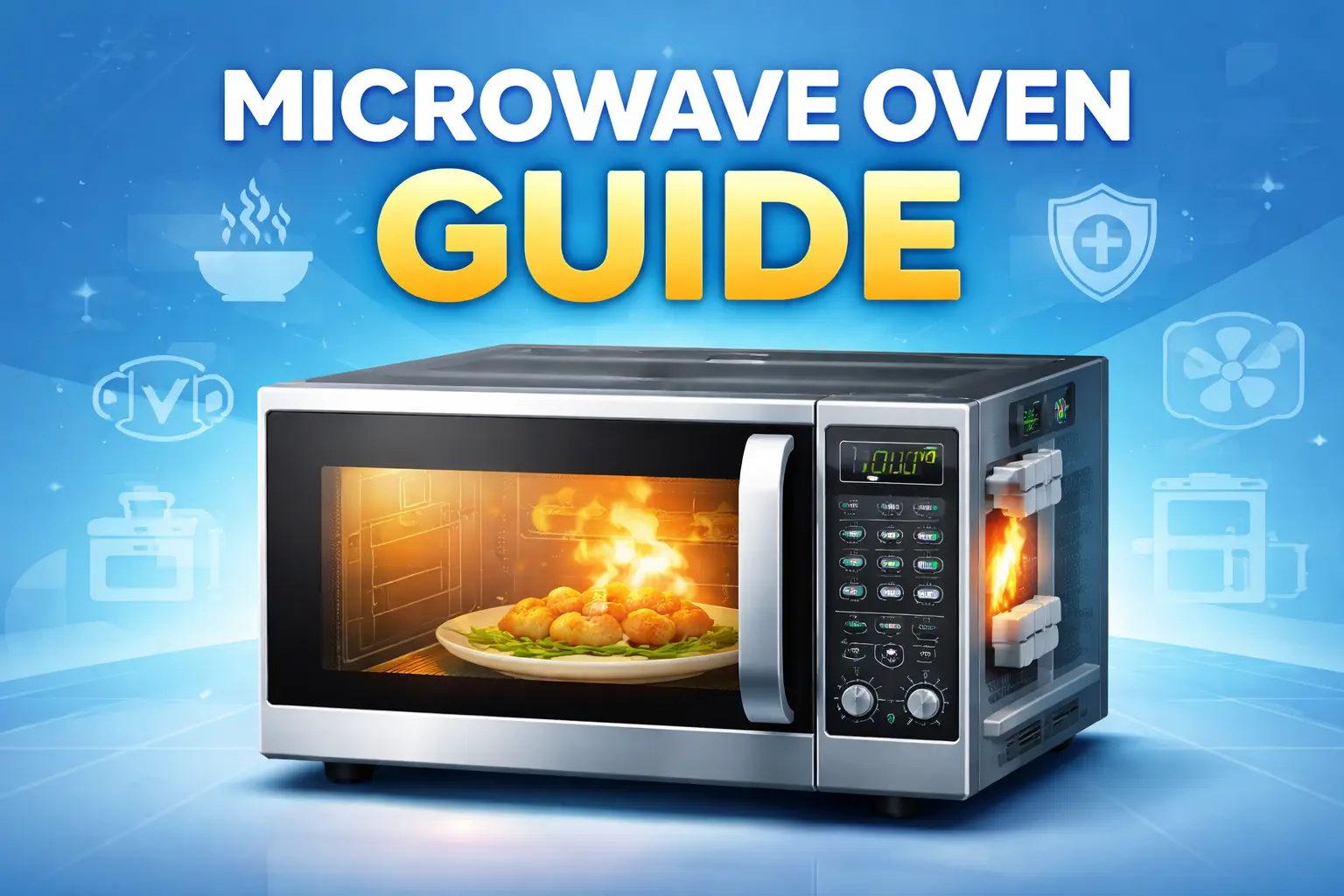
Microwave Oven: Complete Technical, Functional, and Usage Guide
A microwave oven is an electric kitchen appliance designed to heat, cook, and defrost food using electromagnetic radiation in the microwave frequency range, primarily at 2.45 gigahertz.
According to the International Electrotechnical Commission (IEC), a microwave oven operates by generating microwaves through a magnetron, which excites water, fat, and sugar molecules inside food, producing internal heat.
A microwave oven functions as a closed metal cavity with controlled radiation, safety interlocks, and programmed power modulation.
Microwave Oven Historical Development
The microwave oven originated from radar technology research during the mid-20th century.
According to IEEE historical records, the first commercial microwave oven appeared in 1947 as an industrial food-heating device. Domestic microwave ovens became common after solid-state controls, compact magnetrons, and safer enclosures were introduced.
The modern microwave oven evolved through advancements in power efficiency, inverter technology, and sensor-based cooking.
See More: Pappedeckel: A Complete Guide to Modern Fiberboard Lids, Uses & Production
Microwave Oven Working Principle
A microwave oven works through a controlled electromagnetic heating process.
Generate electromagnetic waves.
The magnetron converts electrical energy into microwave radiation.
Transmit radiation.
Waveguides direct microwaves into the cooking chamber.
Absorb energy.
Polar molecules in food absorb microwave energy and vibrate.
Produce heat.
Molecular friction generates thermal energy uniformly inside the food.
Regulate exposure.
Timers, sensors, and power cycles regulate heating duration and intensity.
According to appliance engineering standards, this method heats food volumetrically rather than from the surface inward.
Microwave Oven Main Components
A microwave oven contains several critical components:
| Component | Function |
|---|---|
| Magnetron | Produces microwave radiation |
| Waveguide | Channels microwaves into cavity |
| Turntable | Rotates food for even exposure |
| Control board | Regulates power and timing |
| High-voltage capacitor | Supplies magnetron energy |
| Door interlock system | Prevents radiation leakage |
| Cooling fan | Dissipates heat from components |
According to IEC safety standards, the door interlock system disables microwave generation when the door opens.
Microwave Oven Types by Technology
Microwave ovens differ by heating control and cooking capability.
Solo Microwave Oven
A solo microwave oven performs basic reheating, cooking, and defrosting.
It uses fixed power levels and mechanical or digital timers.
Grill Microwave Oven
A grill microwave oven includes heating elements for surface browning.
It supports grilling and combination cooking modes.
Convection Microwave Oven
A convection microwave oven integrates a fan-assisted heating element.
It enables baking, roasting, and uniform temperature control.
According to appliance classification standards, convection microwave ovens combine radiant heat, hot air circulation, and microwave energy.
Microwave Oven Power Ratings Explained
Microwave oven power output determines heating speed and efficiency.
| Power Range | Usage Category |
|---|---|
| 600–700 watts | Light reheating |
| 800–900 watts | Standard home cooking |
| 1000–1200 watts | Large portions and dense food |
According to energy labeling authorities, higher wattage reduces cooking time but increases electricity demand.
Microwave Oven Capacity Classification
Capacity defines internal volume and suitable household size.
| Capacity | Suitable Usage |
|---|---|
| 17–20 liters | Single users |
| 21–25 liters | Small families |
| 26–30 liters | Medium households |
| 31+ liters | Large families |
Capacity selection affects dish compatibility, cooking uniformity, and workflow efficiency.
Microwave Oven Control Interfaces
Microwave ovens use multiple interface types:
Use mechanical dials.
Rotary knobs control time and power manually.
Use membrane keypads.
Digital buttons offer preset programs.
Use touch panels.
Capacitive displays provide precision input.
Use sensor controls.
Humidity and temperature sensors adjust cooking automatically.
According to user interface studies, sensor-based microwave ovens improve consistency and reduce overheating.
Microwave Oven Cooking Modes
Microwave ovens support multiple programmed modes:
-
Reheat mode
-
Defrost mode
-
Auto-cook programs
-
Combination cooking
-
Weight-based heating
-
Sensor cooking
Each mode modifies duty cycles, power pulses, and heating duration.
Microwave Oven Safety Standards and Compliance
Microwave ovens comply with international safety frameworks.
According to IEC 60335-2-25, microwave ovens must limit radiation leakage below 5 mW/cm².
Manufacturers integrate electromagnetic shielding, choke seals, and interlocked switches.
Additional safety features include:
-
Child lock systems
-
Overheat protection
-
Automatic shutoff
-
Thermal fuses
These measures ensure user safety during operation.
Microwave Oven Materials and Cavity Design
Microwave oven cavities use reflective metal coatings.
Use stainless steel.
Resists corrosion and improves reflection.
Use ceramic enamel.
Simplifies cleaning and resists staining.
Use epoxy-coated steel.
Reduces manufacturing cost.
Cavity geometry influences standing wave patterns and heating uniformity.
Microwave Oven Energy Consumption
Microwave ovens convert electrical energy directly into internal food heating.
According to energy efficiency studies, microwave ovens consume less energy than conventional ovens for short-duration cooking.
Inverter-based microwave ovens optimize power delivery by maintaining consistent energy flow instead of cycling on and off.
Microwave Oven Installation Types
Microwave ovens install in multiple formats:
| Installation Type | Description |
|---|---|
| Countertop | Portable and flexible |
| Built-in | Integrated with cabinetry |
| Over-the-range | Combines exhaust and cooking |
| Drawer-style | Horizontal sliding access |
Installation choice affects ventilation, space usage, and workflow.
Microwave Oven Maintenance Practices
Microwave oven maintenance ensures consistent performance.
Clean interior surfaces.
Food residue absorbs microwaves unevenly.
Inspect door seals.
Damaged seals reduce safety.
Avoid metal objects.
Metal reflects microwaves unpredictably.
Check ventilation paths.
Blocked vents increase thermal stress.
Regular maintenance extends appliance lifespan.
Microwave Oven Common Use Cases
Microwave ovens support diverse applications:
-
Reheating prepared meals
-
Defrosting frozen food
-
Steaming vegetables
-
Cooking grains
-
Melting ingredients
-
Baking with convection models
According to culinary appliance research, microwave ovens improve time efficiency in modern kitchens.
Microwave Oven Advantages
Microwave ovens provide measurable benefits:
-
Reduced cooking time
-
Lower energy consumption
-
Minimal nutrient loss
-
Compact footprint
-
Controlled heating
These benefits explain widespread adoption across residential and commercial kitchens.
Microwave Oven Limitations
Microwave ovens have defined constraints:
-
Limited browning capability without grill
-
Uneven heating without rotation
-
Reduced texture development
-
Material compatibility restrictions
Understanding limitations improves usage accuracy.
Microwave Oven Buying Evaluation Table
| Evaluation Factor | Technical Impact |
|---|---|
| Wattage | Heating speed |
| Capacity | Dish size compatibility |
| Control type | Precision and ease |
| Safety features | Risk mitigation |
| Installation style | Space efficiency |
| Energy efficiency | Operating cost |
This evaluation framework improves selection accuracy.
See More: Casîo: A Comprehensive Guide to the Modern Evolution of a Global Tech Symbol
FAQs
What frequency does a microwave oven use?
A microwave oven uses 2.45 GHz electromagnetic radiation according to international standards.
Does a microwave oven destroy nutrients?
According to food science studies, microwave cooking preserves nutrients due to reduced cooking time and minimal water usage.
Can microwave radiation escape during use?
Certified microwave ovens prevent radiation leakage through shielding and interlock systems.
Why does food heat unevenly in a microwave oven?
Uneven heating results from standing wave patterns and food density variations.
Is inverter technology different from conventional microwaves?
Inverter technology delivers continuous power rather than cycling, improving temperature control.
Conclusion
A microwave oven is a scientifically engineered appliance that applies controlled electromagnetic energy for efficient food heating.
Its performance depends on power output, cavity design, control systems, and safety mechanisms.
Modern microwave ovens integrate sensors, inverter circuits, and multifunctional cooking modes to support diverse culinary tasks.
Understanding technical attributes, operational principles, and compliance standards enables accurate usage, evaluation, and selection.